
St Sampson's High School
KS4/GCSE Revision
This page contains resources created and collated by us to help you with the key areas of revision in the weeks coming up to your exams:
Parental Support
If you have a child about to embark on their ‘GCSE journey’, there are probably any number of questions spinning around your mind. Aside from the obvious one (which is “where has all the time gone? It only seems like yesterday they were at primary school!”) you might well be wondering about the new style of GCSEs, how to encourage good study skills from the outset, and what you might be able to do to support your child in their studies.
GCSEs
In recent years, GCSEs have changed. In short, the new courses include much less coursework (or controlled assessment) than before, with only some of the more practical subjects like Art, Drama and Graphics containing this element of assessment. Most exams will now also be taken at the end of a two-year course, removing the module system that was previously in place for some subjects. Also, in many subjects there have been some changes to the content that they study, and students will be required to answer more essay-style questions too. There is also a new 9 to 1 grading system.
The 9 to 1 grades
The 9 to 1 grading scheme has been introduced by the Department for Education in the hope that the new GCSEs will “better differentiate between students of different abilities”, by allowing greater differentiation for the top levels. The table below shows how the new GCSE grades compare to the old ones – although the DfE is clear to point out that each grade cannot be directly compared, there are places where they can be aligned.
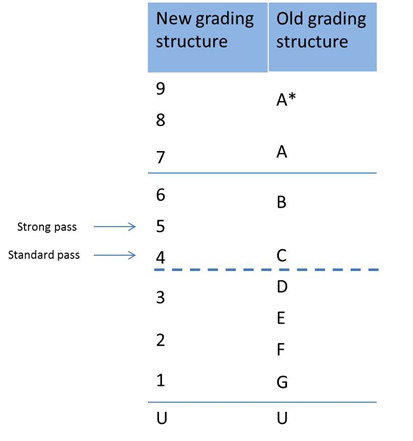
However, whilst your child might well think that GCSEs are ‘far too hard now’ and they’re ‘never gonna be able to do them’ – it’s important that we reassure them that GCSEs may well have changed, but they are still there to do the same job that they have always done. That is, to assess how well you have got to grips with a particular subject!
If you are a good geographer or historian, who has worked hard in class and at home, listened to advice from teachers, attended school regularly and tried their best, then you will be rewarded with the grade you deserve. GCSEs may well have been ‘reworked’ but they will still assess the same skills, knowledge and understanding that they have always done. They might get students to do things slightly differently – but the good scientists and linguists, for example, will still be rewarded with the good grades! Panic over!
Some top tips
- They may have different exercise books for the same subject – being aware of which books they need to take on particular days and creating a space for them to keep their books handy will reduce stress levels no end when they are scrabbling around searching for their school books at 8am.
- Make sure you know what Examination Board and specification your child is studying for each of their subjects (see this link for current).
Encouraging good study skills
Your child may feel really overwhelmed when they start their GCSEs, which is totally understandable. Parents can help take some of the sting out of the ‘stressing’ they will inevitably do:
- They will get homework or what we call ‘Extended Learning’. This will be posted on Classcharts or their Google Classroom. Make sure you have access to their Classcharts account to keep a track of what is being set and when. Check they have joined a Google classroom for each subject. The homework is given to enhance learning, so if your child is unsure, simply write a short note asking for the teacher to explain the homework again.
- Creating a study ‘space’ is a really positive thing to do – away from all distractions if at all possible. I know this is very difficult in some families – but a small, quiet area where your child can take ownership of their learning should bear fruit in the future. Then, make sure your child has everything they need – notebooks, revision books, pens, paper, post- it notes, index cards etc. Perhaps buy folders that allow them to divide and organise their work into sections, so their work is easy to access.
- Smaller tests at regular intervals (one test every half term is common) and a larger ‘exam hall exam’ at the end of the year. It is important that you try to keep these tests and exams in perspective. Until your child gets to the end of the course, in the Summer term of Year 11, these tests and exams are simply a way of the teacher seeing if what he or she has taught you has sunk in. They are as much a test of the teaching strategy used by the teacher as they are of the student themselves. They indicate to the teacher what they need to go through again with the student – as well as what the student needs to pay particular attention to themselves.
- Help your child create an overview of what they need to revise and break each subject down into manageable chunks. This is where knowledge of the Exam Board specification will help.
- Set definite start and finish times for revision sessions and have a clear goal for each session.
- Get your child to ask your teachers for practice questions or past papers.
- Get them to practise making plans and answering questions under timed conditions.
- During breaks do something completely different – listen to music, have a chocolate biscuit, make a cup of tea for example.
- Ensure they make their revision active. Don’t just allow them to read notes – make flash cards, mind maps or use the post-it notes you bought when setting up a study space.
Finally (and perhaps one of the key elements of parental support) it’s important not to stress too much about the transition! In the same way that primary schools aim to form the bedrock of knowledge, skills and understanding that students will need as they progress to secondary school, the secondary school will have been preparing your child for their ‘GCSE journey’ throughout KS3. And, of course, if you do have any concerns about your child’s progress, attitude or effort, just be sure to use parents evenings as an opportunity to develop a positive relationship with the teaching staff – we absolutely want your child to do as well as you do!
And on a final note download this revision tracker and stick it somewhere prominent to help keep track of what subjects have been covered! Encourage them to complete it daily and reward them for their hard work.
Effective Revision Skills
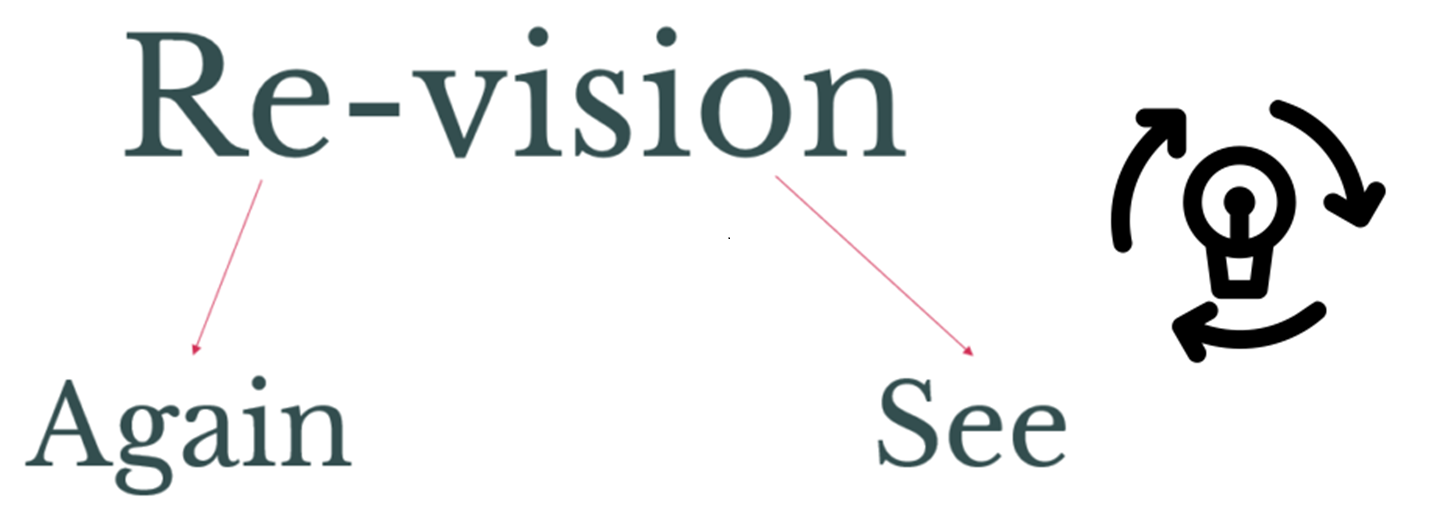
Revision takes place after you have finished learning the content in class. At the end of a unit.
Remember the 3 Rs of revision:
Refine it – know what to revise – check the spec, syllabus, unit checklist.
Prioritise areas to revise – focus on what you find hard. Identify gaps in knowledge. Know where the most marks are.
Create a plan – download a prioritisation sheet or a revision timetable.
Revise it – use a range of active retrieval strategies. Use spaced repetition, revisit your knowledge before you forget it.
Review it – self-test, quiz and practice LOTS of past papers. Check if your revision technique is working. If not, try another.
RIGHT TIME AND PLACE
- Find a quiet place
- Turn off your phone
- Turn off music
- Start early
- Use a table or desk
- Take regular breaks
Managing Stress
Prolonged stress affects our ability to think, learn and remember. This is particularly problematic when exams are a) stress inducing b) need you to think and c) when you have to remember (a lot!) When we are stressed our brains produce more of the hormone cortisol which can make us feel even worse. What we want to produce is the 'happy hormone' dopamine.
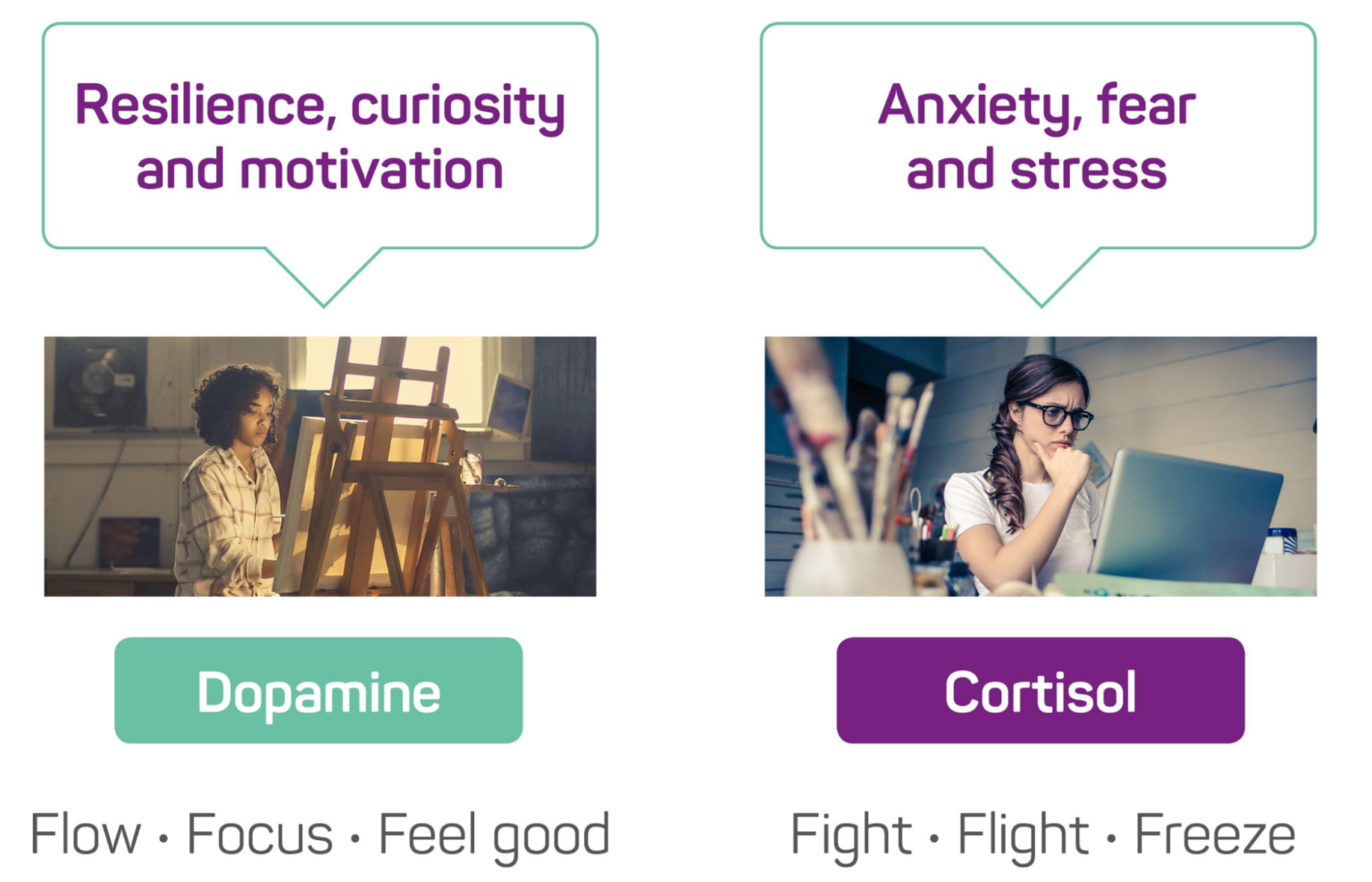
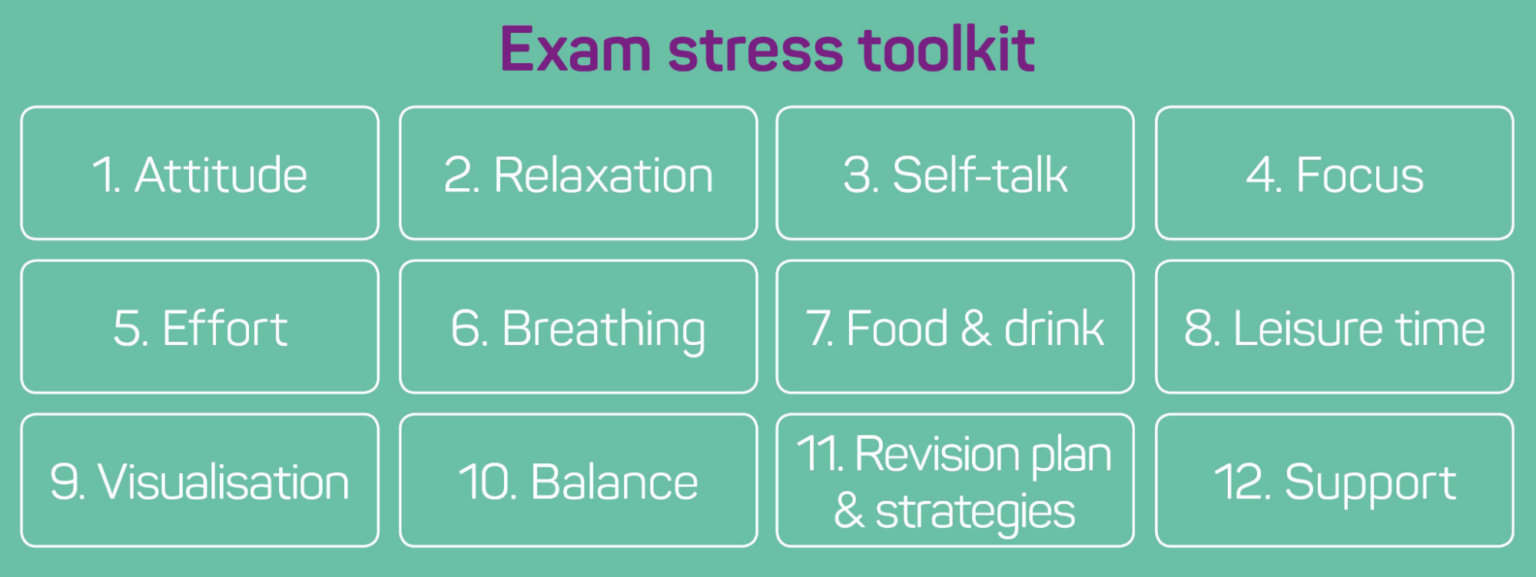
We can overcome the cortisol by building an exam stress busting toolkit. There are a number of ways in which we can do this:
Download the Headspace app for iOS or Android (or access it via YouTube) and complete the free 'Take 10' (as many times as you like).
Revision Strategies
Active recall means generating knowledge from your brain, even if it is hard. The more you are forced to think deeply about something, the more you remember it.
If revision feels easy, you're probably not learning!
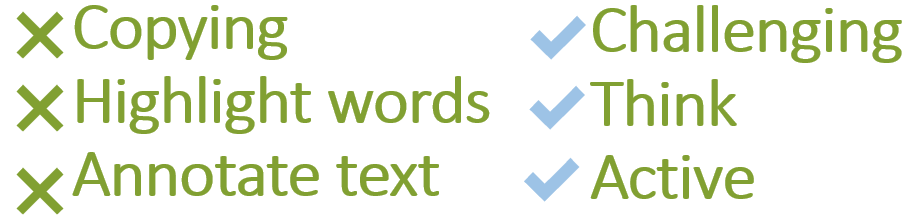
- Realising something is hard, and choosing to do it anyway. Know your academic pain points and attack them.
- Copying notes and highlighting text can make you feel like you've done lots of 'work' leading to a feel good factor. However, it has little impact on your learning/memory.
- Also, ask yourself, is the revision technique you are using making you think? Do the harder stuff- try a past paper, apply your knowledge or explain concepts to another.
- Without actively recalling information - you don't know what you already know. One useful technique to address this is a blank page.
- Blank page - recite everything you know about a topic - attempt to structure the information in a logic way.
- Flashcards - instead of looking at information on a flashcard, you should write a question to force yourself to produce the information.
- Quizzing - quizzing is an effective active recall technique because it makes you think!
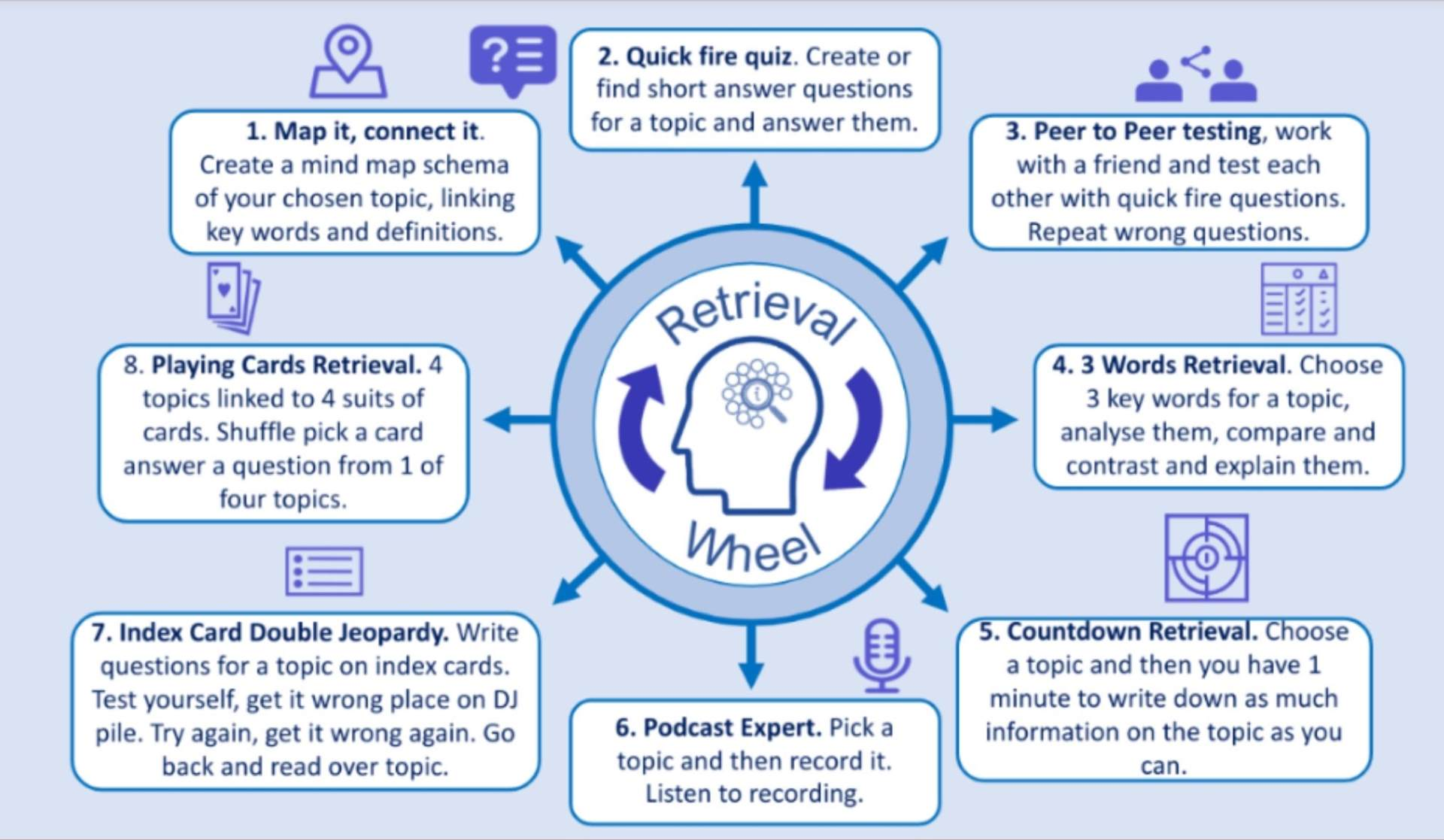
At the bottom of this page we have some revision strategy posters that can be printed off.
Period 7
Summer Exams Provisional Timetable
Subject Links
Y10 Revision Guides : Sheet1
Y11 Revision Guides and Exam Specifications : Sheet1
Recommended Links
Click the links below to make your way to some external resources:
Please note, due to the volume of revision materials on offer for each subject, we are unable to provide access to every resource via this website.
Please also remember that what really matters at this time of year is that you don’t rev in neutral: if you need help, guidance or advice about how to plan / how to revise / mindfulness – please let us know as soon as possible. We are happy to help individuals or even to deliver some group sessions to help support your achievement. Please do come and talk to us: no issue or problem is too small.
The good news is that experts agree that the right preparation can improve your results by two grades. There are many ways to review work, and hard work, planning and starting early will maximise your chances of getting the best grades you can.
Not sure where to start?
Then Try this: